

Last Updated on March 19, 2026
Setting up a SaaS business in India is one of the most promising opportunities in today’s growing digital market. However, compliance is a critical part of building and scaling a SaaS company. From raising funds to managing operations and adhering to legal requirements, every aspect must be handled carefully. Missing any compliance can lead to penalties and legal complications.
This guide provides a complete checklist of compliance requirements for starting and running a SaaS business in India.
A Quick Roadmap
Before starting a SaaS business in India, consider the following:
1. Which business type would you choose- product-based or service-based
There are two types of software industries:
- Product-based industry which includes Microsoft, Google, WhatsApp, Facebook, SlideShare, Telegram, Zoho, etc.
- Service-based industry- cloud, drive, CRM, subscription-based- Netflix, Amazon Prime, Canva, etc.
2. What would your mode of operation be – Development service, Business intelligence, consultancy, or SaaS?
3. Would you want to rent the business premises or own a business premise?
4. What type of business entity would you choose?
5. What would be your source of funding?
6. How would you hire employees and create a team?
Confused about what to choose and how to choose? Contact our start-up experts today.
SaaS Compliance Checklist in India 2026
Software as a Service (SaaS) is a cloud-based platform that delivers software over the internet, allowing users to access applications without installing them locally.
If you are choosing to set-up saas business, you have landed at the right place. Here is a complete checklist of compliance requirements to follow.
Key compliance areas for SaaS Business:
- Decide on your business structure
- Draft a founder’s agreement
- Protect your intellectual property
- Adhere to data privacy laws
- Comply with labour laws
- Obtain licenses and permits
- Follow taxation rules
- Implement ESOPs
- Manage investment and legal compliances
- Follow SaaS security standards
1. Deciding Your Business Structure
Choosing the right business structure is important. Common options include:
- Sole Proprietorship
- Partnership
- One Person Company
- Limited Liability Partnership (LLP)
- Private Limited Company
- Public Limited Company
- Foreign Company
Each structure has its own compliance requirements. For SaaS businesses, LLPs and Private Limited Companies are generally preferred due to funding advantages.
| Entity Type | Incorporation Compliances |
|---|---|
| LLP / Company | • Filing LLP Agreement (for LLP)
• Certificate of Incorporation • PAN and TAN • Opening a current account • GST registration (if applicable) • Filing MCA forms • Maintenance of statutory records • Annual returns • Form 8 (LLP) |
| One Person Company (OPC) | • Appointment of auditor
• Commencement of business declaration • Annual returns filing • Financial statements (Form AOC-4) • Board meeting requirements • EPF, TDS, GST, and ESI compliances |
| Foreign Company | • Filing Form FC-1
• Annual filings (FC-3, FC-4) • Board meetings • FCGPR filings • FLA returns • Director KYC compliance |
For SaaS industries, it is always advisable to opt for an LLP or a private limited company to help you with funding, as both structures also offer structured frameworks for LLP annual compliance and Private Limited Company annual compliance, including ROC filings, tax returns, and regulatory reporting. To determine which business structure will help you secure funding, contact us today.
2. Founder’s Agreement
Since the entire SaaS business relies upon intangible assets—code, intellectual property (IP), and user trust, which is developed by expert personnel, it is always better to have your terms clear with the founders, and we suggest you draft a detailed founder’s agreement to avoid future complexities.
Key Clauses:
- Equity distribution
- Vesting schedule
- Roles and responsibilities
- Decision-making and governance
- Compensation
- Intellectual property ownership
- Confidentiality (NDA)
- Non-compete and non-solicitation
- Dispute resolution
SaaS-Specific Clauses:
- IP assignment (code ownership)
- Vesting protection
- Equity clarity
- Non-compete and confidentiality
| Important clauses in the Founder Agreement that are SaaS Specific | |
| IP Protection and Assignment | The agreement ensures that any code or IP created by a founder is officially transferred to the company and will be treated as company property. |
| Vesting Schedules | Since SaaS products require long-term development and maintenance, this clause will protect against early employee exits. |
| Equity Split and Commitment | It clearly defines how much equity each founder owns based on their contributions. |
| Non-compete clause | Software rests on code, and if you can crack the code, you can create similar software. With these three clauses, the founders restrict their employees from creating, soliciting, or disclosing the software to competitors, thereby protecting their business. |
| Non-solicitation clause | |
| Non-disclosure clause | |
If you require any assistance in drafting or vetting a founders’ agreement, you can connect with our legal expert team.
3. Intellectual Property Rights
For a SaaS business, the intellectual property is the core of the business. The entire SaaS business rests on your source code, algorithms, user interface, and your brand name. It is important to protect them as it will create your brand value and increase your company’s valuation.
Important IP Protection tools:
| S.no | IP tools | What can be protection | What is to be done |
| 1 | Copyright registration | Source code, object code, user interface, and other elements of your website | Apply for copyright protection through the competent authority. |
| 2 | Trademark registration | Company name, logo, taglines, colour, and feature names | File trademark application in Form TM A |
| 3 | Trade secrets | Algorithms, business methods, customer lists, pricing strategies | Draft a non-disclosure agreement with an in-built IP protection clause and enforcement clause. |
| 4 | Patent registration | Software processes and methods that have new technical solutions | File a relevant application before the controller of patents. |
4. Data Privacy Law Compliance
With the rapid growth of the SaaS industry, data protection is one of the most vital steps to avoid legal issues and build customer trust. SaaS companies collect, store, and process large amounts of data- personal data, financial information, and business information, which are sensitive in nature and require to be protected under the law. In simpler terms, protecting privacy is a priority.
Key Principles:
- Data minimization
- Purpose limitation
- Transparency
- Security
Applicable Laws:
- Digital Personal Data Protection Act (DPDP Act), 2023
- GDPR (for European users)
- CCPA (for US users)
SaaS firms must also ensure that data is stored only as long as necessary and that they have appropriate mechanisms for data retention and destruction.
5. Labour Law Compliance
Hiring employees requires compliance with employment laws.
Key Areas:
- Wages and salaries
- Working hours and leave policies
- Employment contracts and documentation
- Provident Fund (PF), ESI, and pension
- Workplace safety
- POSH compliance (sexual harassment prevention)
- Dispute resolution
- Maintenance of digital records
| S.no | Labour laws | Compliances | Governing laws |
| 1 | Wages and salaries |
|
|
| 2 | Working hours, overtime, and holidays |
|
|
| 3 | Employment documentation |
|
— |
| 4 | Social welfare and financial security |
|
|
| 5 | Workplace welfare and safety |
|
|
| 6 | Sexual harassment policies |
|
|
| 7 | Dispute resolution and trade union |
|
|
| 8 | Maintenance of digital records |
|
— |
6. Licenses and Permits
Licenses depend on the business model, location, and nature of services. The type of licenses required for business will depend on the following criteria:
- Type of industry
- Location/state/city of the business
- Type of business model.
Licenses and permits are industry-specific and vary by business. For the SaaS industry, the list of required licenses and permits is typically brief.
Mandatory licenses to be obtained by SaaS business:
There are certain licenses that are mandatory for any business, no matter what business you run. These include:
- GST registration
- Registration under the Shops and Establishment Act
- MSME registration
- Signage license
- Fire safety license
- NOC from the concerned departments
Industry – Specific licenses:
With respect to the SaaS business, the following permits/licenses are required:
- Telecom licenses for communication services- issued by the Department of Telecommunications.
- Software licensing agreement
- The STPI registration – apply online via the official STPI website. The fee is approximately RS. 2,950/-. 2,950/-
Documents required to obtain licenses:
- Business identity proof- certificate of incorporation
- Aadhar card
- Pan card
- TAN
- Address proof of business.
- Financial records- bank account details, audited financial statements
- Details of the software services
- Memorandum of Association
- Articles of association
- Board resolution
- Lease agreements
It is advisable to prepare a checklist in advance before approaching authorities to obtain licenses.
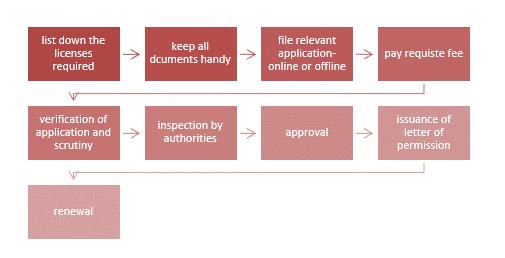
How to obtain these SaaS specific license: step-by-step procedure
7. Software License Agreement
Software license agreements are service agreements between the software developer and its customers that define the extent of software use, how to use it, where to use it, and the software’s installation. It basically controls the use of the software to prevent unauthorised access and infringement. These agreements will also address the customers’ rights to copy, modify, and redistribute the content.
Legal framework governing the Software License Agreements:
- The Indian Contract Act, 1872– E contracts: nature of contract, validity of contract, and breach of contract clauses are dealt with under this Law.
- The Copyright Act, 1957: Software is a copyrightable work under the literary work category, and once developed, it is always better to protect it from infringement.
- Trade Secret Laws: As such, there are no specific laws governing trade secrets; breaches of confidentiality can be dealt with under Contract Law.
- IT Act, 2000: This legislation is significant for electronic contracts and internet-related aspects of agreements.
8. Taxation Compliance
SaaS start-up tax compliance is overwhelming. There are many times when the business overlooks tax compliance.
- GST compliance
- TDS compliances
- Broader tax compliance
GST Compliances
| S.NO | DESCRIPTION | COMPLIANCE |
|---|---|---|
| 1 | Tax Rates | Inter-state supply: 18% IGSTIntra-state supply: 9% CGST + 9% SGST |
| 2 | Input Tax Credit (ITC) | ITC can be claimed on business expenses used for providing SaaS services, subject to eligibility and proper documentation. |
| 3 | Export and Cross-border Sales | Export of SaaS services is treated as a zero-rated supply. Two options:
• Export under LUT (no GST) • Export with IGST and claim a refund |
| 4 | Registration Requirement | Mandatory GST registration for SaaS providers supplying through online platforms or inter-state services, even if turnover is below ₹20 lakhs. Otherwise threshold:
• ₹20 lakhs (general states) • ₹10 lakhs (special category states) |
| 5 | SAC Code | SAC: 9983 (Other professional, technical and business services)Common SaaS-related codes:
• 998313 – IT infrastructure & support services • 998314 – IT design & development • 998315 – Hosting services • 998316 – IT system management |
| 6 | Invoicing | Must include: GSTIN, SAC code, place of supply, invoice number. E-invoicing mandatory if turnover exceeds ₹5 crore |
| 7 | Returns Filing | • GSTR-1: Monthly / Quarterly (based on scheme)
• GSTR-3B: Monthly • Due date: Typically 11th / 13th (GSTR-1) and 20th (GSTR-3B) |
| 8 | Reverse Charge Mechanism (RCM) | Applicable in specific cases (e.g., import of services, certain notified services). Under RCM, the recipient pays GST (usually IGST in cross-border cases). |
TDS Compliances
| S.NO | DESCRIPTION | COMPLIANCE |
|---|---|---|
| 1 | Tax Deductions (Indian Payments) | • Section 194J: 10% for professional/technical services (if > ₹30,000/year)
• Section 194C: 1% (individual/HUF) or 2% (others) for contractors. Threshold: ₹30,000 per transaction or ₹1,00,000 annually |
| 2 | Payments to Foreign Companies | TDS applicable under Section 195 if the payment is taxable in India. Rates depend on nature of payment and DTAA. Equalisation Levy (2%) may apply for certain SaaS/digital services. |
| 3 | Returns Filing | • Monthly TDS deposit: 7th of next month
• Quarterly returns: Forms 26Q (domestic), 27Q (non-resident) |
| 4 | Consequences of Non-Compliance | • Interest on late payment
• Penalty and late fees • Disallowance of expenses (up to 30%) |
Other Compliances
| S.NO | DESCRIPTION | COMPLIANCE |
|---|---|---|
| 1 | Start-up India Tax Benefits | Eligible startups can claim 100% tax exemption for 3 consecutive years out of 10 years under Section 80-IAC, subject to DPIIT recognition. |
| 2 | Income Tax Return Filing | Mandatory for all companies/LLPs, even if there is no revenue or profit. |
| 3 | Maintenance of Records | Maintain books of accounts, invoices, payroll records, and compliance documents as per the Companies Act and Income Tax Act. |
| 4 | Softex Compliance | Mandatory for export of software/services.Filing of SOFTEX forms to RBI/STPI for reporting export value and foreign remittances. |
9. ESOP for SaaS Startups
ESOPs are a powerful tool for creating wealth and management that helps employers retain employees. It fosters a sense of loyalty and trustworthiness among employees. For the SaaS industry, it allows them to offer competitive pricing and compensation to its employees, and since developing software requires long-term time investment, it is generally advisable to retain employees in the business.
Key components to be considered for structuring ESOP for the SaaS industry:
- Formulate a plan
- Determine the Vesting period
- Consider the tax implications
- Alignment of interest
- Decide the share prince
- Define buy-back terms
- Exit strategy.
For detailed information on ESOP and its compliance – click here.
10. Investment and Legal Compliance
If you are planning to raise funds and start a business, here is what you need to do:
- Draft a term sheet
- Draft a shareholder’s agreement
- Have a clear share-subscription agreement
- Maintain all records of tax returns, contracts, cap tables, etc
If you plan to bring in foreign investment for your business, you will have to adhere to FEMA guidelines as well.
11. SaaS Security Standards
SaaS security standards address the protection of cloud-hosted data. This is critical for managing operational risks and protecting sensitive information from cybercrimes. The two most widely recognised security frameworks are SOC 2 and ISO/IEC/27001.
Conclusion
Compliance is a crucial part of running a SaaS business in India. Proper adherence to legal, tax, and regulatory requirements helps avoid penalties and ensures smooth business operations. Following this checklist will help build a strong and legally compliant SaaS business.
How Can Kanakkupillai Assist You?
We at Kanakkupillai aim to offer simplified solutions to reduce these complexities so you can focus on growing your business, and we take care of all your startup compliance and legal needs. Contact us today to know more.
FAQs
1. Which business structure is feasible for a SaaS business?
It is advisable to opt for a private limited company or LLP. It also depends on the location, nature, and type of business.
2. Can I draft a founder’s agreement on my own?
Yes, but considering its complexities, it is always advisable to seek legal assistance.
3. Is it important to adhere to data privacy laws?
Yes. Non-compliance can result in significant legal charges.
4. What are the security measures to be followed by SaaS companies?
The two most widely recognised security frameworks are SOC 2 and ISO/IEC/27001.