


Last Updated on March 16, 2026
SaaS (Software as a Service) is a widely used technology model in today’s digital economy. With rapid technological advancement and digitalisation, software development has evolved into a major business opportunity. However, protecting a software brand is equally important in this competitive market. Since software programs cannot be patented in many cases under Indian IP law, SaaS trademark registration in India becomes a crucial step for brand protection. A trademark for software companies helps safeguard the brand name, logo, and identity associated with the software platform.
This article provides a detailed overview of trademarks in SaaS branding. The following topics will be discussed:
- Introduction
- What is SaaS?
- Key Features of SaaS
- Examples of SaaS Platforms
- Why Trademark is Important for SaaS Brands
- Trademark Classes for SaaS (Class 9 vs Class 42)
- Trademark Registration Process
- Documents Required for Trademark Registration
- Cost of Trademark Registration
- Timeline for Trademark Registration
- Common Mistakes to Avoid
- Frequently Asked Questions
- How Kanakkupillai Can Help
SaaS – Meaning and its key Aspects
Software as a Service is a cloud platform that delivers software online. People around the world can access these applications. SaaS uses a subscription model where customers do not have to buy or install software on their own computers or servers.
Why has this concept gained popularity?
- SaaS simplifies software management for customers by providing a cost-effective, convenient way to access applications.
- These applications are highly scalable and allow customers to choose subscription models tailored to their needs.
- Easy to access and convenient to use.
- Easy on maintenance and hassle-free installation.
What are the Key features of SaaS?
Here are a few features that make SaaS a market-friendly and cost-effective option for all entrepreneurs:
- Users can access SaaS via web browsers or mobile applications that support mobile work.
- You pay only for what you use or need because SaaS uses subscriptions. This helps you plan your finances.
- One software serves multiple customers, helping the business earn strong profits.
- With updated software, users can overcome the need for manual updates and interventions.
- You only need a good internet connection and proper compliance management.
Examples of SaaS Platforms
Some popular SaaS platforms used worldwide include:
- CRM – Salesforce, HubSpot
- File Storage – Google Drive, Dropbox
- Collaboration – Slack, Microsoft Teams
- Web Design – Wix, Squarespace
- E-commerce – Shopify
- HR & Finance – Zoho People, QuickBooks
- IT & Security – Cloudflare
- Online Streaming – Netflix, Amazon Prime
TRADEMARKING SaaS Brands
For SaaS startups and digital platforms, brand identity is one of the most valuable assets. Through SaaS trademark registration in India, businesses can legally protect their brand name and prevent competitors from using similar marks. A trademark for software companies also builds credibility, strengthens market recognition, and helps in long-term brand growth.
When you open Netflix or Amazon Prime, do you see the “R” symbol next to the logo? Do you know what it means? It means the brand is protected under trademark law. It serves as a badge of authenticity, making users believe it is a genuine brand, trustworthy, and free of virus issues.
Securing your brand at the early stage of business is crucial—trademarking your SaaS brand not only prevents legal complexities but also protects your unique identity and builds customer trust. This part of the article will guide you through a step-by-step process of trademarking your SaaS brands.
Note: Class 42 and Class 9 of the trademark classes specifically deal with SaaS brands, and you have to conduct a preliminary search in these classes to ensure your brand is unique, distinctive, and registrable under the Trademarks Act.
Why Trademark Protection is Important for SaaS Brands
Trademark registration is crucial for protecting SaaS businesses. Since software itself cannot be patented under Indian IP law, a trademark helps protect the brand name, logo, and identity associated with the software.
Key benefits include:
- Prevents competitors from using a similar brand name
- Builds customer trust and brand credibility
- Provides legal protection against infringement
- Creates a valuable intangible business asset
- Helps in global brand expansion
Trademark Classes for SaaS (Class 9 vs Class 42)
| Class 9 | Class 42 |
| Downloadable software | Software development services |
| Mobile Applications | SaaS platforms |
| Electric devices | IT consulting |
| Firmware | Cloud computing |
| AI tools | Website design |
| Other digital and scientific products | Cyber security |
Filing in both classes provides comprehensive protection for SaaS businesses. Without securing registration in class 9, your brand may be subject to registration of a similar brand, and without class 42, your brand may be exposed to competitors offering similar software services. To sum up, a multiclass application will avoid these complexities and eliminate the risk of infringement.
Procedure for Filing a Trademark Application for SaaS Brands
The process of SaaS trademark registration in India follows the standard trademark filing procedure under the Trademarks Act, 1999. Software companies must ensure that their brand name and logo are unique before applying for a trademark for software companies in the relevant trademark classes.
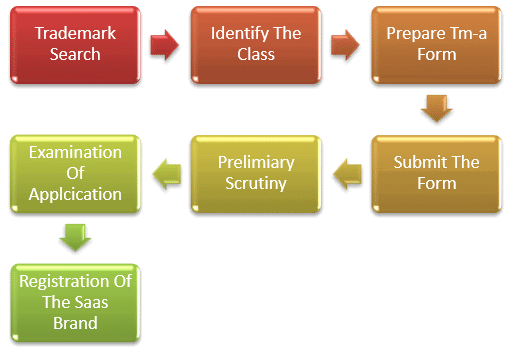
1. First things first, conduct a thorough trademark search across all classes, particularly classes 9 and 42, to ensure your brand is unique and distinctive. The time you invest at this point will help you save time in subsequent processes, making them easier and less objectionable. Therefore, it is always better to be sure before applying that your brand logo is unique, distinct, and not in competition with any other brand.
2. Once you are assured that your SaaS brand is unique and not similar to any other brand, you can proceed to file an application by completing the TM-A form with all required details and prescribed fees. You can do it on your own, but it is always advisable to consult trademark experts.
3. Once the form is filled out, you will need to upload documents proving your address, a power of attorney, and, most importantly, an illustration of your brand. Thereafter, your application will be under review by the trademark examiners.
4. Once the application is filed and the documents are uploaded, the Registrar/Examiner will scrutinise the application and do a formality check.
5. Prepare an examination report: The report can have two of the findings:
- The application is accepted and can be published in the journal.
- The application is rejected on either absolute grounds or relative grounds (section 9 or section 11)
- Based on the report, in the second option, the examiner will require the applicant to file a reply to the examination report stating the grounds for registering the mark.
6. Once the registrar is satisfied that the mark is capable of registration, it will accept the application and issue a certificate of trademark registration. The same will be entered in the registry and published on the website.
Documents Required for Trademark Registration
The list of documents will vary by entity. Here’s what you need:
Basic documents
- A clear illustration in specified JPG, PNG format within the prescribed mb
- Form TM-A
- Power of Attorney
- Proof of business
- User affidavit (if Applicable)
- Digital signature certificate
Entry- specific documents:
Proprietor/Individual:
- PAN Card and Aadhaar Card (ID and Address proof).
- MSME/Udyam Certificate (Optional, to claim 50% fee concession).
Private Limited Company/LLP:
- Certificate of Incorporation.
- Authorised Signatory’s ID proof (Aadhaar or PAN).
- Board Resolution (Authorising a director to file).
Startups:
- DPIIT Recognition Certificate (Mandatory to claim the startup fee concession of 50%).
- Udyam Registration Certificate.
Cost of filing the trademark application
The official fees for filling a single class application depend on the nature of the business and mode of filing:
| Nature of Business | Physical Filling (INR) | E-filing (INR) |
| Individual/ startups and MSMEs | 5000 | 4500 |
| Companies and other entities | 10500 | 9000 |
| Renewal fees | 10000 | 9000 |
| Expedite processing fees for individuals/startups and MSMEs | NA | 20000 |
| Expedite processing costs for companies. | NA | 40000 |
Timeline
| Drafting, filing, and uploading of the application with documents | 2-3 days |
| Formality check | 2-3 working days |
| Reply to formality check. | Within 30 days from the date of issue of the notice |
| Formality check pass | 5-7 working days |
| Examination | 10-15 working days |
| Reply to the examination report. | Within 30 days from the date of issue of the notice |
| Opposition to advertising | Within 4 months from the date of issue of the notice |
| Reply to opposition | Within 60 days from the date of issue of notice |
| Filing of rejoinders | Within 60 days from the date of issue of notice |
| Total time taken | 12–24 months (normal), 6–9 months only if no objection/opposition |
Common Mistakes to Avoid When Filing a SaaS Trademark
Many SaaS startups make mistakes while applying for trademark registration. Some common mistakes include:
- Choosing a generic or descriptive brand name
- Not conducting a proper trademark search
- Filing only in one class instead of multiple classes
- Incorrect specification of software services
- Not responding to examination reports on time
Avoiding these mistakes can significantly increase the chances of successful trademark registration.
Frequently asked questions
1. Can SaaS software be patented in India?
No, software programs alone cannot be patented under Indian patent law unless they involve a technical invention. However, SaaS brands can be protected through trademark registration.
2. Which trademark class is most important for SaaS?
Class 42 is usually the primary class for SaaS services, while Class 9 protects downloadable software and applications.
3. Who can file a trademark Application?
Any person claiming to be the proprietor of the trademark can file for registration of the trademark.
4. How to Register a Trademark?
Registration of trademarks is done by the Controller General of Patents, Designs and Trademarks (Registrar of Trademarks), situated at Chennai, Mumbai, Kolkata, Ahmedabad, and Delhi. The Application for registration must be filed within the territorial jurisdiction of the Applicant’s place of business. Applicant.
5. When do I have to renew a registered trademark?
Trademark protection is valid for 10 years, and upon expiry of the said term, it can be renewed from time to time upon payment of the prescribed fees to the registrar. The renewal period is for 10.
6. Do I have to apply to both?
It is up to you to choose whether to apply in class 9 or class 42, but always apply in both for better protection.
7. Is it a good idea to start a SaaS Brand business?
Yes, a definite yes. It is trending and becoming the most popular business option.
How can Kanakkupillai help?
From trademark search and brand evaluation to application filing and registration, Kanakkupillai provides complete SaaS trademark registration services in India. Our experts assist startups and software companies in securing trademarks to protect their brand identity and business reputation.