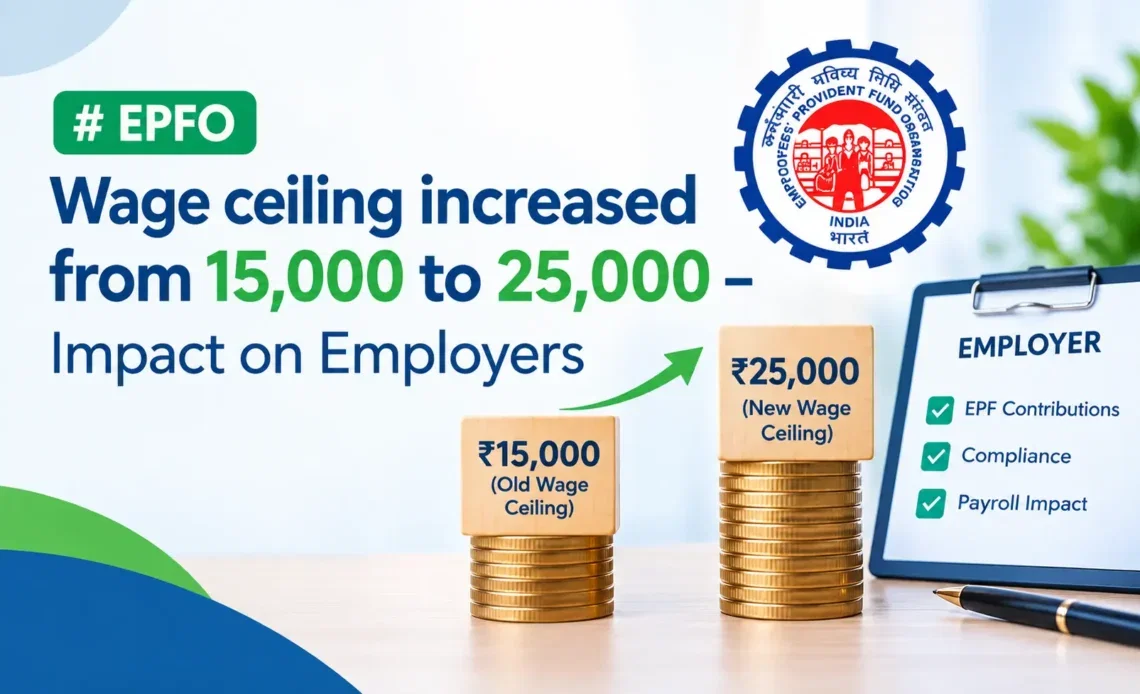
The Government of India has increased the wage ceiling for mandatory coverage under the Employees’ Provident Fund Organisation (EPFO) from ₹15,000 to ₹25,000 per month, effective 17 September 2026.
The change expands mandatory social security coverage to eligible employees earning wages above ₹15,000 and up to ₹25,000 per month, subject to the applicable EPF provisions.
The revision has important implications for employers, payroll teams and employees, particularly businesses that currently have employees earning between ₹15,000 and ₹25,000 who are not EPF members.
The Government stated that the change is expected to bring more than 51 lakh additional employees under mandatory EPFO coverage.
What Is the EPFO Wage Ceiling?
The EPFO wage ceiling is the statutory wage threshold used for determining mandatory EPF coverage, subject to the applicable provisions of the EPF framework.
Before this revision, the wage ceiling for mandatory coverage was ₹15,000 per month.
From 17 September 2026, the ceiling has been increased to ₹25,000 per month.
| Particulars | Earlier | From 17 September 2026 |
| EPFO mandatory coverage wage ceiling | ₹15,000/month | ₹25,000/month |
| Increase | — | ₹10,000/month |
| Effective date | — | 17 September 2026 |
The ceiling had remained at ₹15,000 since its previous revision in September 2014.
Who Is Affected by the New EPFO Wage Ceiling?
The change primarily affects employees who fall within the ₹15,000 to ₹25,000 wage range and were previously outside mandatory EPF coverage because their wages exceeded the earlier ₹15,000 threshold.
Example
Suppose an employee earns applicable EPF wages of ₹20,000 per month.
Under the earlier ₹15,000 ceiling, a new employee earning ₹20,000 would generally not be automatically covered solely on the basis of the mandatory wage threshold.
With the revised ceiling of ₹25,000, such an employee can fall within mandatory EPF coverage, subject to the applicable statutory conditions.
Newly covered employees can receive benefits under the applicable EPFO schemes, including:
- Employees’ Provident Fund (EPF)
- Employees’ Pension Scheme (EPS)
- Employees’ Deposit Linked Insurance Scheme (EDLI)
The Government estimates that the revision will extend mandatory social-security coverage to more than 51 lakh additional employees.
What Happens to Employees Already Registered Under EPF?
The impact depends on how the employer currently calculates EPF contributions.
Employees whose PF contribution is restricted to ₹15,000
Employers who were restricting contributions to the earlier statutory ceiling will need to review the contribution wage under the revised framework.
Where contributions are restricted to the applicable ceiling, the revised ceiling can increase the contribution base from ₹15,000 to ₹25,000.
For example:
Earlier maximum employee contribution:
₹15,000 × 12% = ₹1,800 per month
At the revised ₹25,000 ceiling:
₹25,000 × 12% = ₹3,000 per month
Therefore, where the full revised ceiling applies, the employee’s monthly contribution can increase by up to ₹1,200.
However, the ₹25,000 figure is a wage ceiling and not a flat PF contribution amount. The actual contribution depends on the applicable EPF wage and the employee’s membership and contribution arrangements.
Does Every Employee Earning More Than ₹15,000 Have to Pay PF on ₹25,000?
Not necessarily.
The revised ₹25,000 threshold should not be interpreted as meaning that every employee earning above ₹25,000 will automatically have PF deducted on ₹25,000.
Employers must determine:
- Whether the employee is covered under EPF;
- The employee’s applicable EPF wages;
- Whether contributions are being restricted to the statutory ceiling or made on higher actual wages; and
- Whether any specific statutory or scheme provisions apply.
For employees already contributing on actual eligible wages above ₹25,000, the increase in the statutory ceiling may not necessarily result in an additional 12% employer/employee contribution solely because the ceiling has changed.
Therefore, employers should review their existing payroll structure rather than applying a blanket ₹25,000 contribution rule.
Impact on Employer PF Contributions
The impact on an employer depends on the existing contribution practice.
Employers currently restricting PF contributions to ₹15,000
For eligible employees whose contributions were previously restricted to ₹15,000, the revised ceiling can result in a higher contribution base.
At the full ₹25,000 ceiling:
Employee share at 12%: ₹3,000
The employer’s contribution is distributed between EPF and EPS as applicable under the relevant rules.
The employer may therefore see an increase in its statutory outgo for affected employees.
Employers already contributing on actual eligible wages
Where an employer is already contributing based on actual eligible wages above ₹25,000, the change in the ceiling may have a different impact. The employer should review the allocation between EPF and EPS and the applicable EDLI and administrative charges.
The exact treatment depends on the employee’s circumstances and the applicable EPFO provisions.
September 2026 Is a Transition Month
Since the revised ceiling became effective on 17 September 2026, September requires special attention from payroll teams.
The contribution calculation needs to account for the period:
1 September to 16 September 2026
→ Earlier ₹15,000 ceiling
17 September to 30 September 2026
→ Revised ₹25,000 ceiling, wherever applicable
Therefore, employers should ensure that their September payroll and ECR calculations correctly reflect the effective date of the change.
What Employers Need to Do ?
Employers should review their payroll and EPF records rather than waiting for an issue to arise during ECR filing.
1. Identify affected employees
Prepare a list of employees whose applicable wages fall between:
₹15,000 and ₹25,000 per month
Pay particular attention to employees who are currently outside EPF coverage.
2. Review existing EPF members
Identify employees whose EPF contribution is currently restricted to the old ₹15,000 ceiling.
Review whether the contribution needs to be revised under the new framework.
3. Update payroll systems
Payroll software and salary calculations should reflect the revised ceiling wherever applicable from 17 September 2026.
4. Review UAN and KYC records
For employees who become newly covered, employers should ensure that the required UAN and KYC-related formalities are completed.
5. Recheck September ECR
September 2026 requires a split-period calculation because the revised ceiling became effective in the middle of the month.
6. Communicate with employees
Employees affected by the change should be informed if their PF deduction or take-home salary changes.
7. Review employment and payroll documents
Employers should review:
- Salary structures
- Payroll masters
- Offer letters
- CTC structures
- PF policies
- Contractor payroll compliance
This is particularly important where the employer’s CTC structure is linked to statutory contributions.
Does the EPFO Change Affect ESIC?
No.
The increase in the EPFO wage ceiling does not automatically change the ESIC wage ceiling.
Employers should therefore continue to evaluate EPF and ESIC eligibility separately based on the respective applicable provisions.
EPFO Wage Ceiling: Quick Comparison
| Particular | Earlier | Revised |
| Mandatory EPF coverage ceiling | ₹15,000/month | ₹25,000/month |
| Effective date | — | 17 September 2026 |
| Employee contribution at full ceiling* | ₹1,800 | ₹3,000 |
| Difference at full ceiling* | — | ₹1,200 |
| Newly affected wage range | — | ₹15,001–₹25,000 |
*Illustrative calculation at 12% where the full statutory ceiling is the applicable contribution base. Actual contribution depends on the applicable EPF rules and employee circumstances.
Frequently Asked Questions
What is the new EPFO wage ceiling in 2026?
The wage ceiling for mandatory EPFO coverage has been increased from ₹15,000 to ₹25,000 per month, effective 17 September 2026.
Who will be newly covered under EPF?
Eligible employees earning above ₹15,000 and up to ₹25,000 per month who were previously outside mandatory EPF coverage because of the earlier wage ceiling may come under mandatory coverage, subject to applicable statutory conditions.
Will my PF deduction increase because of the new ceiling?
It can, depending on how your employer currently calculates PF contributions and whether the revised ceiling applies to your contribution base.
At a ₹25,000 contribution base, 12% employee contribution would be ₹3,000.
Does the ₹25,000 ceiling mean everyone must contribute ₹3,000?
No. ₹25,000 is the revised wage ceiling, not a fixed PF contribution amount. The actual contribution depends on the applicable EPF wages and rules.
What happens to employees earning more than ₹25,000?
The revised mandatory coverage ceiling does not mean that every employee earning above ₹25,000 automatically becomes a new mandatory EPF member. Coverage depends on the applicable EPF provisions and the employee’s membership status.
What should employers do for September 2026?
Employers should account for the revised ceiling from 17 September 2026 and ensure that payroll and ECR calculations correctly reflect the applicable pre- and post-effective-date periods.
Does this change affect ESIC?
No. The EPFO wage ceiling revision is separate from ESIC eligibility and its applicable wage ceiling.
Conclusion
The increase in the EPFO wage ceiling from ₹15,000 to ₹25,000 is a significant change for employers and employees.
For employers, the immediate priority should be to identify affected employees, review existing PF contribution practices, update payroll systems and ensure that September 2026 contributions are calculated correctly.
For employees, the change can mean broader access to EPF, pension and insurance-related social-security benefits. It may also increase the employee’s PF deduction where the contribution base moves from ₹15,000 to the revised ceiling.
Businesses should review their individual employee and payroll circumstances before implementing changes, as the impact of the revised ceiling can differ depending on existing EPF membership and contribution practices.
Need help with payroll and statutory compliance
Kanakkupillai can help businesses review their compliance requirements and manage statutory filings.
Sources / References :