

Last Updated on September 24, 2026
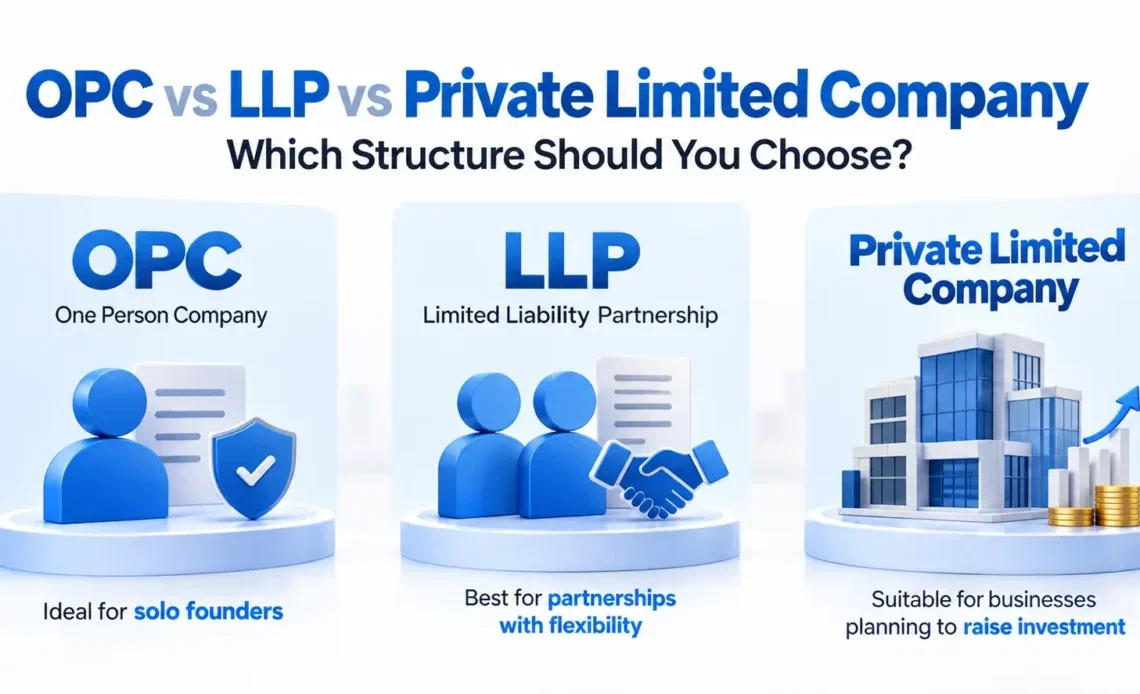
Choosing between a One Person Company (OPC), a Limited Liability Partnership (LLP), and a Private Limited Company is one of the first decisions a founder makes and it shapes everything downstream: how much compliance you carry, whether you can raise equity funding, how you’re taxed, and how easily you can bring in co-founders or investors later. There’s no single “best” structure; each is built for a different situation. This guide compares all three side by side on the factors that actually matter for that decision, then walks through which structure tends to fit which kind of founder.
Quick Comparison: OPC vs LLP vs Private Limited Company
| Factor | OPC | LLP | Private Limited Company |
|---|---|---|---|
| Commonly considered by | Solo founders who want a corporate structure and don’t currently need co-owners | Businesses with two or more partners that value partnership flexibility and don’t require conventional equity-share funding | Businesses expecting multiple shareholders, equity investment or employee equity arrangements |
| Members/owners | 1 member + mandatory nominee | Minimum 2 partners; no statutory maximum | 2–200 members, subject to statutory rules |
| Minimum directors/designated partners | 1 director | 2 designated partners; at least 1 resident in India | 2 directors |
| Separate legal entity | Yes | Yes | Yes |
| Liability protection | Limited | Limited | Limited |
| Equity-share funding | Cannot admit a second shareholder while remaining an OPC | Does not issue equity shares like a company | Can issue equity shares and other permitted securities |
| Statutory audit | Annual statutory audit applies | Generally required when turnover exceeds ₹40 lakh or contribution exceeds ₹25 lakh | Annual statutory audit |
| Taxation (AY 2026-27) | Domestic-company tax provisions same as Private Limited Company | 30%, plus applicable surcharge and cess | 22% under Section 115BAA if conditions are met; otherwise 25% or 30% depending on applicable conditions |
| Board/partner meetings | Relaxed requirements; an OPC with one director is exempt from Section 173 meeting requirements | No statutory board-meeting requirement; governed by the LLP agreement | Generally 4 board meetings annually, subject to applicable exemptions |
| Annual General Meeting | Exempt | Not applicable | Mandatory |
| Conversion path | Can voluntarily convert to a Private Limited Company by meeting the applicable requirements and filing the prescribed conversion documents | Can register as a company under Part I of Chapter XXI of the Companies Act, 2013, subject to the applicable requirements | Can convert into an OPC or LLP subject to eligibility conditions |
What Each Structure Actually Is
One Person Company (OPC): A company owned and run by a single individual, who gets limited liability and a separate legal identity that a sole proprietorship doesn’t offer. A nominee is mandatorily appointed at incorporation to ensure the company continues if the sole member dies or becomes incapacitated. Full detail: One Person Company Registration.
Limited Liability Partnership (LLP): A hybrid structure that combines a partnership’s operational flexibility with a company’s limited liability. At least two partners are required, of whom at least two must be designated partners responsible for regulatory compliance, and at least one designated partner must be resident in India meaning that person has stayed in India for at least 120 days during the financial year. Full detail: Limited Liability Partnership Registration.
Private Limited Company: A company owned by shareholders (minimum 2, maximum 200) and run by a board of directors (minimum 2, maximum 15), built specifically to support external investment, employee stock options, and eventual scale. It is commonly used by startups seeking institutional equity investment because it supports share-based ownership and equity issuance. Full detail: Private Limited Company Registration.
Ownership and Control
An OPC is structurally capped at one member that’s the entire point of the structure, and it’s also its main limitation: you cannot add a co-owner without converting to a different structure. An LLP has no upper limit on partners and splits control between designated partners (who carry compliance responsibility) and other partners, governed by the LLP agreement. A Private Limited Company separates ownership (shareholders) from management (directors) a structure that scales cleanly as you add co-founders, employees with equity, and outside investors, up to 200 shareholders.
Liability Protection
All three structures offer limited liability a foundational reason to move away from a sole proprietorship or a traditional partnership firm in the first place. In each case, liability is generally limited to what the owner has invested (capital contribution for an LLP partner, unpaid amount on shares for a company shareholder), subject to the applicable Act, rather than extending to personal assets. None of the three is a meaningful differentiator on liability protection alone the differences that matter are in compliance burden, taxation, and funding readiness, covered below.
Compliance and Annual Filing Requirements
| Requirement | OPC | LLP | Private Limited Company |
|---|---|---|---|
| Statutory audit | Required annually | Generally required when turnover exceeds ₹40 lakh or contribution exceeds ₹25 lakh | Required annually |
| Annual filings | Financial statements + annual return with the RoC | Form 11 (Annual Return, due within 60 days of financial year end) and Form 8 (Statement of Account & Solvency, due within 30 days of the 6-month mark after financial year end) | Financial statements (AOC-4) + annual return (MGT-7) with the RoC |
| Board/partner meetings | At least 1 per half of the calendar year, with a gap of at least 90 days, where there’s a single director | No statutory board-style meeting requirement | At least 4 board meetings a year, with a gap not exceeding 120 days between two consecutive meetings |
| AGM | Exempt | Not applicable | Mandatory |
| Overall compliance load | Moderate | Generally lower recurring compliance burden, particularly where the LLP remains below the statutory audit threshold | Highest most filings, mandatory audit, mandatory AGM |
An LLP generally has a lower recurring compliance burden than the other two structures when it remains below the ₹40 lakh turnover / ₹25 lakh contribution audit threshold, since the audit requirement doesn’t arise solely on that basis though actual compliance still depends on the LLP’s specific activities, transactions, and applicable filings. Both an OPC and a Private Limited Company require an annual statutory audit; the Private Limited Company adds the mandatory AGM and more frequent board meetings on top. That said, an annual audit requirement doesn’t mean every audit-related obligation is identical across company sizes — MCA’s exemption notification specifically excuses OPCs and small companies from certain auditor-reporting requirements under Section 143(3)(i), among other targeted relaxations.
Taxation
An OPC and a Private Limited Company are taxed identically, since both are companies under the Income Tax Act there’s no OPC-specific tax rate. For AY 2026-27, domestic companies can opt into the concessional regime under Section 115BAA (a flat 22%, plus applicable surcharge and cess, in exchange for foregoing specified exemptions and deductions), regardless of turnover. A company that doesn’t opt in is taxed at 25% where its turnover or gross receipts in FY 2020-21 did not exceed ₹400 crore, or 30% for other domestic companies that 25% rate is tied to that specific base year (FY 2020-21), not the company’s current turnover, so it’s worth confirming eligibility rather than assuming it based on today’s numbers. Companies opting for 115BAA are also exempt from Minimum Alternate Tax (MAT); companies that don’t opt in remain subject to MAT under Section 115JB.
An LLP is taxed differently as a partnership, not a company. For AY 2026-27, LLP profits are taxed at a flat 30% (plus applicable surcharge and cess), with no equivalent to the 22%/25% concessional company rates. The offsetting advantage: profit distributed to partners isn’t taxed again in their hands, since there’s no dividend distribution tax on an LLP’s profit-sharing (unlike a company, where dividends are taxed in the shareholders’ hands since the Dividend Distribution Tax was abolished from FY 2020-21). LLPs are subject to Alternate Minimum Tax (AMT) under Section 115JC broadly the LLP equivalent of MAT rather than MAT itself.
Fundraising and Investment Readiness
This is usually the deciding factor for founders planning to raise outside money. A Private Limited Company is commonly used for this it can issue equity and preference shares, run an ESOP pool, and is the structure institutional investors (angels, VCs, PE funds) most commonly invest through. An LLP has no share capital or ESOP mechanism in the same sense, so most institutional investors avoid investing directly into one LLPs are typically funded through partner contributions and debt, not equity rounds. An OPC is the most constrained of the three here: because it’s structurally limited to a single member, it cannot bring in outside equity investors at all without first converting to a Private Limited Company.
Conversion Flexibility
OPC → Private Limited Company: An OPC can voluntarily convert into a Private Limited Company by meeting the applicable requirements and filing the prescribed conversion documents (including Form INC-6). The ₹50 lakh paid-up capital / ₹2 crore turnover figures that used to force mandatory conversion under the old rules were removed by the Companies (Incorporation) Second Amendment Rules, 2021 conversion today is a voluntary business decision, not something a threshold requires, though it still involves meeting the applicable eligibility conditions and procedural steps rather than happening automatically.
LLP → Private Limited Company: An LLP can register as a company under Part I of Chapter XXI of the Companies Act, 2013, subject to the applicable requirements. Under the Companies (Authorised to Register) Rules, an entity with fewer than seven members registers as a private company.
Private Limited Company → OPC or LLP: Also possible, subject to eligibility conditions (for conversion to an OPC, this generally means bringing the shareholder count down to one and meeting OPC eligibility; for LLP, it involves its own conversion process) a less common path in practice, since most conversions run the other direction as businesses scale up rather than down.
Cost of Registration and Ongoing Compliance
Government filing fees for all three vary by authorised/contributed capital slab and change periodically, so exact figures are best confirmed at the time of incorporation rather than quoted here. Directionally: an LLP’s ongoing compliance cost tends to be lower than the other two structures when it remains below the audit threshold, since it avoids a mandatory annual audit and has fewer recurring filings; an OPC sits in the middle, with an annual audit requirement but a lighter meeting and filing load than a Private Limited Company; a Private Limited Company carries the highest ongoing compliance cost, driven by the mandatory audit, AGM, and more frequent board meetings and filings.
Which Structure Fits Your Situation
| Your situation | Structure that typically fits |
|---|---|
| Solo founder, no plans to add a co-owner soon, wants limited liability | OPC |
| Two or more founders, services/professional business, no near-term plan to raise equity funding | LLP |
| Planning to raise angel/VC/PE funding, run an ESOP pool, or bring in multiple co-founders | Private Limited Company |
| Solo founder today, but expects to raise funding or bring in a co-founder within a year or two | Private Limited Company from the start, or OPC with a planned conversion |
| Consulting, professional services, or a business prioritizing low compliance overhead | LLP |
None of these three is a universally “better” choice the right one depends on how many owners you have today, whether you’ll raise equity funding, and how much annual compliance you’re prepared to carry. If you’re unsure, a quick conversation with a professional before you incorporate is far cheaper than converting structures later.
Frequently Asked Questions
Is LLP better than OPC?
Neither is universally better an LLP needs at least two partners and suits businesses with co-founders that want a light compliance load, while an OPC is built specifically for a single founder. The right choice depends on how many owners you have and how you plan to fund the business.
Can an OPC have more than one shareholder?
No, an OPC is structurally limited to one member. To add co-owners, you’d need to convert to a Private Limited Company.
Can an LLP raise funding from investors?
Not in the way a Private Limited Company can. An LLP has no share capital or ESOP mechanism, so most institutional investors prefer to invest in a Private Limited Company rather than an LLP directly.
Is a Private Limited Company suitable for a startup?
A Private Limited Company can be suitable where the business expects multiple shareholders, equity investment or employee equity arrangements. A solo founder or a business with two or more partners that does not need conventional equity funding may also consider an OPC or LLP, respectively.
Which structure generally has a lower compliance burden?
An LLP can have a lower recurring compliance burden when it remains below the statutory audit threshold of ₹40 lakh turnover and ₹25 lakh partner contribution, because the audit requirement does not arise solely on that basis. Actual compliance requirements depend on the entity’s activities, transactions and applicable filings.
Can I convert my OPC into a Private Limited Company later?
Yes, an OPC can voluntarily convert into a Private Limited Company by meeting the applicable requirements and filing the prescribed conversion documents. This isn’t forced by a capital or turnover threshold since the 2021 amendment removed the old mandatory-conversion triggers, but it does still involve meeting eligibility conditions and following the prescribed procedure.
Can I convert my LLP into a Private Limited Company later?
Yes, an LLP can register as a company under Part I of Chapter XXI of the Companies Act, 2013, subject to the applicable requirements.
Is an LLP or a Private Limited Company taxed at a lower rate?
For AY 2026-27, an LLP is taxed at a flat 30% (plus surcharge and cess) on its profits, with no dividend distribution tax on profit-sharing to partners. A company can opt for a flat 22% under Section 115BAA for the same assessment year. Which works out lower in practice depends on your specific profit level, surcharge slab, and whether profits are retained or distributed it’s worth modelling both scenarios with your CA rather than assuming one is always cheaper.