
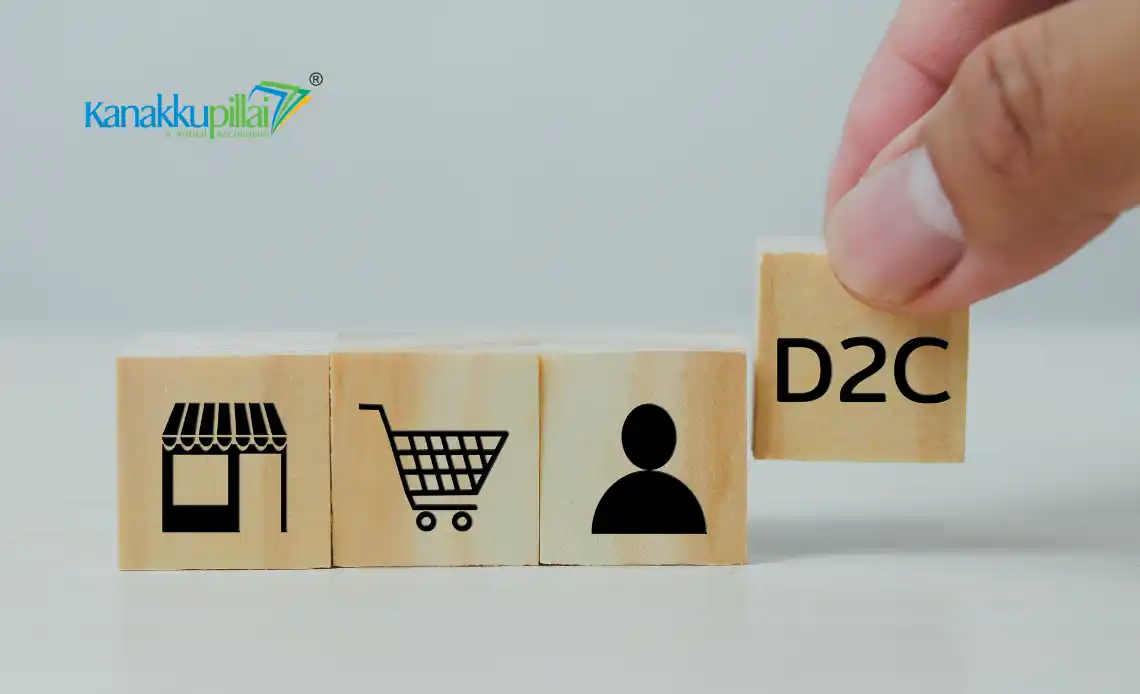
A private limited company is the best entity for a D2C brand that plans to raise money from angel investors, venture capital funds or other institutional investors, because it can issue equity shares, preference shares, convertible instruments and ESOPs. An LLP can suit a bootstrapped D2C brand that does not plan to raise equity, and a proprietorship or partnership works only for very small ventures testing the market. Ready to start? See our private limited company registration service, or company registration in Chennai if you are in Tamil Nadu.
Direct-to-Consumer (D2C) is one of the most popular models through which businesses sell their products to customers without going through traditional distributors. D2C businesses have become attractive in many sectors with the rise of e-commerce, digital marketing and online shopping. Choosing the right business structure at the start supports efficiency, profitability and sustainable growth. The structure decides how easily the brand can raise money, bring in investors, give ownership to its team and expand. Understanding the options will help founders take the right course of action.
Quick Summary
Choosing the right business structure is an important decision for a Direct-to-Consumer (D2C) brand, especially when future funding is a priority. The ideal entity depends on ownership, liability protection, operational needs, and plans to attract investors.
- Private Limited Company: Generally the preferred structure for D2C brands planning to raise equity funding, bring in investors, and scale operations.
- LLP: Suitable for founders who prefer a flexible ownership structure and do not have immediate plans to raise equity capital.
- Partnership Firm: Can work for small businesses with multiple owners, but offers less personal liability protection and may be less attractive to institutional investors.
- Sole Proprietorship: Suitable for an individual starting small, but does not provide a separate legal identity or limited liability.
- Funding Consideration: A Private Limited Company generally offers a more suitable framework for issuing shares, structuring investor ownership, and raising equity.
Planning to launch or scale your D2C brand?
Choose the right business structure and get professional assistance with Private Limited Company registration and incorporation compliance.
Best Business Structure for a D2C Brand in India for Funding
Direct-to-consumer businesses sell their products directly to the consumer without intermediaries. To meet their funding and growth goals, they need to choose the right business structure. For a D2C business seeking angel investors, venture capital or institutional capital, a private limited company is the most suitable structure. An LLP can be a good option for bootstrapped brands, while partnerships and proprietorships have restrictions regarding finance and ownership.
| Entity | Best Suited For | Equity Funding | ESOPs | Limited Liability |
| Private Limited Company | Brands planning to raise investor funding | Yes | Yes | Yes |
| One Person Company | Solo founders testing the brand | Not until converted | No | Yes |
| LLP | Bootstrapped brands with partners | Difficult | No | Yes |
| Partnership Firm | Small ventures between partners | No | No | No |
| Sole Proprietorship | Very small ventures and market testing | No | No | No |
What Exactly Is a D2C Brand?
A Direct-to-Consumer (D2C) brand is a business that makes, markets and ships its products straight to the consumer without going through middlemen such as wholesalers, distributors or retailers. The approach lets brands reach consumers through their own websites, mobile apps, social media channels, online marketplaces and, in some cases, their own physical stores.
One of D2C’s main benefits is greater control over pricing, branding, marketing, distribution and customer relationships. It also helps brands gather data about consumers, understand their buying habits and build a distinct customer experience.
D2C brands are found in many sectors, including fashion, beauty, cosmetics, personal care, food and beverages, technology and lifestyle products. By cutting out layers of distribution, brands can improve their margins and build close relationships with customers. The approach is increasingly common among startups and growing businesses that want to build their own brand identity and grow online.
Which Entity Is the Best for a D2C Brand from a Funding Point of View?
Choosing the right form of business organisation for a D2C brand becomes crucial, especially for raising external funding and scaling operations. In India, a D2C brand can choose any of these structures: sole proprietorship, partnership firm, One Person Company (OPC), Limited Liability Partnership (LLP) or private limited company. From the point of view of fundraising and scalability, a private limited company is the most appropriate choice for a D2C brand.
The following points explain each structure and how attractive it is from an investor’s point of view:
-
Private Limited Company – Most Suitable for Fundraising
- It is the most preferred structure for D2C startups that need angel investment, venture funding or private equity funding.
- A private limited company has a separate legal identity, limited liability and a clear shareholding structure.
- It can issue equity shares, preference shares and ESOPs, and can have up to 200 members.
See signs your business needs private limited company registration.
-
Limited Liability Partnership (LLP) – Good Option for Bootstrapped Brands
- An LLP offers limited liability, a separate legal identity and lower compliance than a company.
- It can work for founders who want to start a small D2C brand using their own savings or with a few partners.
- However, an LLP has no share capital and no shareholders. Investors can come in only as partners through capital contribution.
- As a result, it is hard to raise equity from venture capital funds and institutions, which almost always invest through shares.
See private limited company vs LLP and our LLP registration service.
-
One Person Company (OPC) – For Solo Founders
- An OPC lets a single founder get limited liability and a separate legal identity.
- But it can have only one member, so it cannot bring in investors or co-founders as shareholders.
- An OPC can be converted into a private limited company voluntarily when the founder is ready to raise funds. See one person company registration and conversion of OPC into private company.
-
Partnership Firm – Few Funding Options
- Starting a partnership firm is relatively easy and straightforward.
- However, the partners have unlimited personal liability, and there is no share capital structure for investors.
- Such a structure is unattractive to institutional investors and unsuitable for D2C brands seeking to grow through external investment.
-
Sole Proprietorship – Good for Small Ventures Only
- A sole proprietorship can be a good option for someone starting a small D2C venture with limited resources, or testing a product before committing to a larger structure.
- However, a sole proprietorship has no legal existence separate from its owner, and it cannot transfer ownership or take equity investment.
- It does not suit a brand with expansion plans. See proprietorship vs private limited company.
-
Ability to Attract Different Kinds of Investment
- A private limited company can raise money through equity shares, preference shares, Compulsorily Convertible Preference Shares (CCPS) and Compulsorily Convertible Debentures (CCDs). A DPIIT-recognised startup company can also issue convertible notes.
- These instruments make it easier for founders and investors to agree on ownership, valuation and the terms of investment.
-
Investor Confidence and Exit Options
- Investors prefer private limited companies because ownership is clearly defined through shares, and they have clear exit routes, such as selling their shares to a new investor, a buyback by the company, an acquisition of the company, or an IPO in the future.
-
DPIIT Startup Recognition
- Private limited companies, LLPs and registered partnership firms can apply for recognition as a startup under the Startup India initiative if they are less than 10 years old and their turnover has not exceeded ₹100 crore in any year.
- Recognised startups can benefit from various government schemes. However, the income tax holiday under Section 80-IAC is available only to eligible companies and LLPs, and most investor-facing benefits work best for companies.
See our Startup India registration service.
-
Compliance and Governance
- A private limited company has more compliance, such as a statutory audit, yearly ROC filings and board meetings. However, these procedures ensure proper financial governance and transparency.
- These records are very useful during investor due diligence. See annual compliance of a private limited company and our due diligence
-
Future Scalability
- D2C brands need large sums of money for inventory, manufacturing, logistics, marketing, technology, distribution and customer acquisition.
- A private limited company is the best choice for raising this kind of funding in the future.
Note: If a D2C brand needs to raise funds from angel investors, venture capitalists or institutional investors, it is better to start as a private limited company from day one. An LLP can work well for a bootstrapped business, but it will have to go through a conversion process later if it decides to raise equity.
Thus, a private limited company is the best choice for an investor-funded D2C brand in India.
Detailed Comparison of Business Structures for a D2C Brand
| Basis | Private Limited Company | LLP | OPC | Partnership Firm | Sole Proprietorship |
| Governing law | Companies Act, 2013 | LLP Act, 2008 | Companies Act, 2013 | Indian Partnership Act, 1932 | No specific law |
| Separate legal entity | Yes | Yes | Yes | No | No |
| Liability | Limited | Limited | Limited | Unlimited | Unlimited |
| Minimum owners | 2 shareholders | 2 partners | 1 member | 2 partners | 1 owner |
| Maximum owners | 200 members | No limit | 1 member | 50 partners | 1 owner |
| Equity investment | Easy | Difficult | Not possible | Not possible | Not possible |
| ESOPs | Yes | No | No | No | No |
| Foreign investment | Yes, subject to sector rules | Only in sectors allowed under the automatic route | Limited | Restricted | Restricted |
| Compliance | High | Moderate | Moderate | Low | Low |
| Income tax rate | 22% plus surcharge and cess under the concessional regime | 30% plus surcharge and cess | 22% plus surcharge and cess under the concessional regime | 30% plus surcharge and cess | Slab rates of the owner |
See the annual compliance comparison of OPC, private limited company, LLP and sole proprietorship and the difference between a partnership firm and an LLP.
How D2C Brands Raise Funds at Each Stage
| Stage | Common Sources | Usual Instrument |
| Idea and launch | Founders’ savings, friends and family | Equity shares or loans |
| Early traction | Angel investors, angel networks, accelerators | Equity, CCPS or convertible notes |
| Growth | Venture capital funds | CCPS |
| Working capital | Banks, NBFCs, revenue-based financing | Loans and credit lines |
| Scale | Private equity, strategic investors | CCPS or equity |
Each fundraising round in a company is done through a private placement or a preferential allotment under the Companies Act, with a valuation report and filings with the ROC. Where the investor is a non-resident, reporting to the RBI under FEMA is also needed. See our services for change in share capital, increase in authorised capital, share transfer and FDI filing with RBI.
Good news for funded startups: the angel tax provision, which taxed share premium received by closely held companies above fair value, was abolished from 1 April 2024.
Registrations and Licences Every D2C Brand Needs
The right entity is only the first step. A D2C brand also needs these registrations to sell online and receive payments:
- GST registration: generally required for selling through e-commerce marketplaces, regardless of turnover. Small sellers making only intra-state sales through marketplaces may be exempt, subject to conditions. See GST registration and GST return filing.
- Trademark registration: a D2C brand’s name and logo are its most valuable assets. File the trademark in the company’s name before launching. See trademark registration, brand name registration and trademark registration for a private limited company.
- Legal Metrology registration: needed for packing or importing pre-packaged goods, with the MRP and required declarations shown on the package and on online listings. See our legal metrology certificate
- FSSAI licence: for food, beverage and nutrition brands. See FSSAI registration.
- Product-specific licences: for example, a cosmetics manufacturing or import licence for beauty brands, or BIS certification for notified products.
- Udyam (MSME) registration: gives access to MSME schemes and priority lending. See MSME registration.
- IEC: if the brand imports raw materials or sells to customers abroad. See IEC registration.
- Current account and payment gateway: both need the entity’s KYC documents, which is easier with a company or LLP.
D2C brands must also follow the Consumer Protection (E-Commerce) Rules, 2020, which require seller details, return and refund policies and a grievance officer, and the Digital Personal Data Protection Act, 2023, when collecting customer data. See the e-commerce business compliance calendar in India.
Already Started as a Proprietorship or LLP? You Can Convert
Many D2C brands start small and convert when investors show interest.
- Proprietorship to private limited company: incorporate a company and transfer the business to it. The transfer can be tax-neutral if the conditions of the Income-tax Act are met, including the proprietor holding at least 50% of the voting power for five years. See sole proprietorship to private limited company and when to convert a proprietorship to a private limited company.
- LLP to private limited company: an LLP can be registered as a company under the Companies Act. See conversion of LLP to private company.
- OPC to private limited company: can be done voluntarily at any time. See conversion of OPC into private company.
Converting before an investment round avoids delays, because investors usually make conversion a condition before they release money. Remember to move the trademark, GST registration, bank accounts and marketplace seller accounts to the new entity.
Advantages of a D2C Business Model
The Direct-to-Consumer (D2C) approach has many advantages, since it lets brands sell their products to customers directly without intermediaries like wholesalers, distributors and retailers. It allows companies to manage their operations, customer relationships, pricing and brand. The main advantages of the D2C business model are:
- Direct Customer Interaction: D2C brands interact with their customers directly, without intermediaries. This helps them understand customers’ likes and dislikes and respond to feedback quickly.
- Higher Profit Margin: By not paying distributors, wholesalers and retailers, D2C brands can earn better margins. However, these savings are partly offset by the cost of marketing, customer acquisition, logistics and returns, so margins depend on how well these costs are managed.
- Brand Image and Control: D2C brands control their brand image through marketing, packaging and communication with customers.
- Consumer Data: By selling online through their own websites and mobile apps, D2C brands can collect information about customer behaviour and use it for marketing and decision-making.
- Personalised Customer Experience: D2C brands can analyse customer data and tailor the experience through personal recommendations, promotions and loyalty programmes.
- Rapid Innovation: With direct customer feedback, brands can quickly identify market needs and improve their products.
- Pricing Flexibility: The brand is free to set prices, offer discounts and run promotions.
- Wider Market Reach: D2C brands can reach customers across India and abroad without owning retail stores, by selling through their websites, social media and marketplaces.
- Better Inventory Management: Since brands get direct data on sales and demand, they can plan stock better and reduce waste.
- Scalability and Growth: The D2C model allows brands to expand their product range, enter new markets, sell digitally and build a strong brand identity.
- Higher Customer Retention: Through direct contact by email, social media, loyalty programmes and customer care, brands can keep customers engaged and encourage repeat purchases.
- Business Flexibility: Brands dealing directly with customers have more flexibility in choosing their sales channels and ways of engaging customers.
In summary, D2C lets brands build direct relationships with their market, gain operational flexibility and understand their customers better.
Common Mistakes D2C Founders Make with Their Business Structure
- Starting as a proprietorship and launching the brand in the founder’s personal name, which makes the transfer harder later.
- Registering the trademark in a co-founder’s personal name instead of the company’s name.
- Splitting shares equally among co-founders without a founders’ agreement or vesting.
- Raising money from friends and family informally, without issuing shares or documenting loans.
- Choosing an LLP to save on compliance and then having to convert just before the first funding round.
- Ignoring GST registration while selling on marketplaces.
D2C Brands in Chennai and Tamil Nadu
Tamil Nadu has a growing D2C ecosystem, with apparel and knitwear brands from Tiruppur, home and kitchen brands from Coimbatore, food and snack brands from Madurai and Tirunelveli, and beauty, wellness and tech-enabled brands from Chennai.
- Registration: a private limited company or LLP with its registered office in Tamil Nadu is registered with ROC Chennai, and the process is fully online.
- State support: the Tamil Nadu Startup and Innovation Mission (StartupTN) runs programmes for early-stage startups, including seed grant support for eligible DPIIT-recognised startups based in the state. Check the current eligibility before applying.
- Local registrations: plan for GST registration, a trade licence from the local body, professional tax and FSSAI where the brand sells food.
- Manufacturing clusters: brands sourcing from Tiruppur, Coimbatore or Karur can register for Udyam and use MSME benefits for working capital loans.
See company registration in Chennai, LLP registration in Chennai, GST registration in Chennai, trade licence registration in Chennai and how company registration helps in getting business loans in Chennai.
Checklist for Setting Up a Fundable D2C Brand
- Register a private limited company if you plan to raise investor funding.
- Sign a founders’ agreement covering shareholding, roles, vesting and exit.
- File the trademark in the company’s name.
- Get GST registration and the product-specific licences before listing on marketplaces.
- Open a current account and set up a payment gateway in the company’s name.
- Keep accounts clean from day one, with monthly bookkeeping and timely filings.
- Apply for DPIIT recognition if eligible.
- Keep the cap table and statutory registers updated for investor due diligence.
Conclusion
Selecting the right business structure is essential when setting up and growing a D2C brand. While proprietorships and LLPs can be suitable for ventures that need little investment, a private limited company is the best structure if you need to raise external funds and bring in investors.
Planning to Launch and Scale Your D2C Brand?
Choose the right business structure for your D2C brand with professional guidance. Get assistance with Private Limited Company registration, business documentation and compliance to build an investor-ready business structure for future growth and fundraising.
Frequently Asked Questions (FAQs)
1. What is the best legal structure for a D2C brand in India?
A private limited company is the most common and suitable structure for a D2C brand, since the founders usually need external investment to build and scale the business.
2. Can an LLP raise investment for a D2C brand?
An LLP can raise money through loans, partners’ contributions and other sources. However, it cannot issue equity shares like a company can, which discourages institutional investors and venture capitalists.
3. Why do investors prefer private limited companies?
Investors prefer private limited companies because of their shareholding structure, ability to issue equity and convertible instruments, limited liability, governance and easier exits.
4. Can a proprietorship be converted into a private limited company?
Yes. A proprietorship can be converted into a private limited company by incorporating a company and transferring the business to it, which involves documentation, the transfer of assets and liabilities, and meeting the applicable tax conditions.
5. Is it mandatory for a D2C brand to register as a private limited company?
No. There is no legal requirement for a D2C brand to be a private limited company. Founders can choose the structure that suits their needs, but a company is the better choice if they plan to raise investor funding.
6. Can a D2C brand start as an OPC?
Yes. An OPC suits a solo founder who wants limited liability. When the founder wants to bring in co-founders or investors, the OPC can be converted into a private limited company.
7. Can a D2C startup give ESOPs to employees?
Yes, if it is a company. ESOPs can be issued only by companies, not by LLPs, partnership firms or proprietorships.
8. Is GST registration compulsory for a D2C brand selling online?
Generally, yes, when selling through e-commerce marketplaces. Small sellers making only intra-state sales may be exempt, subject to conditions.
9. Can a D2C brand get DPIIT startup recognition?
Yes, if it is a private limited company, LLP or registered partnership firm that is less than 10 years old, has turnover below ₹100 crore in every year, and works towards innovation or a scalable business model.
10. Can foreign investors invest in an Indian D2C brand?
Yes, in a private limited company, subject to the FDI policy. A brand selling its own products online is generally treated as single-brand retail trading, so check the sector conditions and complete the RBI reporting after allotment.
11. Should the trademark be registered before or after incorporation?
Ideally, after incorporation, in the company’s name, so the brand belongs to the company. If you file before incorporation in your personal name, assign it to the company later.
12. Is the process different for a D2C brand in Chennai?
No. The registration process is the same across India and fully online. Companies and LLPs with a registered office in Tamil Nadu are registered with ROC Chennai.
Build Your D2C Brand with Kanakkupillai
Building a D2C brand requires the right structure, registrations and compliance. With Kanakkupillai, you get professional help with company registration, choosing the right legal entity, trademark registration, GST registration, fundraising documentation, business plans, virtual CFO services, accounting and ongoing legal compliance. Our professionals handle registration and compliance, leaving you free to focus on building and growing your brand.
Talk to our experts today to set up your D2C brand the right way.
Official Sources