Central FSSAI License
Planning to start or expand a food business that requires an FSSAI Central License? Get professional assistance with the complete application process. We help assess the applicable licence requirements, organise the necessary documents, prepare the application and submit it through the FoSCoS portal. ^From checking business details to addressing application-related clarifications, our team helps keep the process clear and organised. Whether the business involves food manufacturing, import, export or other activities covered under the Central Licence category, get the required support to complete the application correctly and maintain the necessary food-safety compliance.



1,12,845+
Happy and satisfied customers.
FSSAI Central License – Quick Overview
Get a quick overview of the FSSAI Central License, including eligibility, turnover limits, fees, documents, application process, validity and key licensing updates.
| Particulars | Details |
|---|---|
| What is it? | Licence for food businesses falling under Central Licensing Authority criteria |
| General Turnover Limit | Above ₹50 crore annually from 1 April 2026 |
| Other Eligible Businesses | Importers, exporters, eligible e-commerce and certain multi-State food businesses |
| Application Portal | FoSCoS |
| Application Form | Form B |
| Government Fee | Generally ₹7,500/year, depending on KOB |
| Validity | Perpetual validity, subject to applicable compliance and regulatory conditions |
| Key Documents | Identity proof, business details, premises proof, food product details and KOB-specific documents |
| Processing | Online application, document review and inspection/clarification where applicable |
| Main Authority | FSSAI / Central Licensing Authority |
| Key 2026 Update | Revised turnover thresholds and perpetual validity framework |
| Important Check | Eligibility depends on turnover, KOB, activity, location and production capacity, not turnover alone |
What Is an FSSAI Central License and When Is It Required?
From 1 April 2026, FSSAI revised its turnover-based licensing framework, with Central Licence generally applying to businesses with annual turnover above ₹50 crore. However, turnover is not the only eligibility factor. Businesses such as food importers, exporters, eligible e-commerce food businesses and certain multi-State food operators may require a Central Licence based on their business activity, even if their turnover is below ₹50 crore.
An FSSAI Central License is issued by the Food Safety and Standards Authority of India (FSSAI) to Food Business Operators (FBOs) that fall under Central Licensing Authority criteria. Before applying, businesses should check their Kind of Business (KOB), turnover, production capacity, location and food activity to select the correct licence category.
FSSAI Registration vs State vs Central License
From 1 April 2026, FSSAI revised the turnover-based classification for food businesses. However, turnover is not the only factor—certain food activities require a Central Licence based on the nature of the business.
| Criteria | FSSAI Registration | FSSAI State License | FSSAI Central License |
|---|---|---|---|
| General turnover | Up to ₹1.5 crore | Above ₹1.5 crore to ₹50 crore | Above ₹50 crore |
| Typical businesses | Small food shops, petty food businesses, small food operators | Restaurants, manufacturers, distributors and other eligible State-level businesses | Large food businesses and specified Central-level activities |
| Import / Export | Generally not applicable | Generally not applicable | Applicable where prescribed |
| E-commerce food business | not applicable | not applicable | Central category |
| Multi-State food business | Depends on activity | Depends on activity | Central requirements may apply |
| Issuing authority | Registration Authority | State Licensing Authority | Central Licensing Authority |
Important: A business should not select its FSSAI category based on turnover alone. The Kind of Business (KOB), food activity, location, production capacity and other applicable conditions should also be checked before applying.
Who Needs an FSSAI Central License?
An FSSAI Central License is required for specific food businesses based on their business activity, turnover, location and Kind of Business (KOB). From 1 April 2026, businesses with turnover above ₹50 crore generally fall under Central Licensing, but some activities require a Central Licence regardless of turnover.
Common examples include:
- Food importers and exporters
- Eligible e-commerce food businesses
- Large food manufacturers and processors
- Food businesses operating across multiple States/UTs
- Food businesses at airports and seaports
- Certain Central Government food operations
- Other businesses specifically covered under the Central Licence KOB criteria
FSSAI Central License Eligibility Criteria in 2026
From 1 April 2026, FSSAI follows revised turnover limits for food-business licensing. A Central FSSAI Licence is generally applicable when annual turnover exceeds ₹50 crore, but turnover alone does not decide eligibility.
A business should check these key factors:
- Annual Turnover: Above ₹50 crore under the general Central Licence category.
- Business Activity: Importers, exporters, eligible e-commerce food businesses and other specified activities may require a Central Licence regardless of turnover.
- Multiple Locations: Certain businesses operating across multiple States/UTs may fall under Central Licensing requirements.
- Production Capacity: Applicable manufacturers and processors must consider their prescribed capacity limits.
- Kind of Business (KOB): The exact FSSAI KOB should match the actual food activity carried out by the business.
Why Is an FSSAI Central License Important for Food Businesses?
An FSSAI Central License is more than a regulatory requirement—it helps eligible food businesses operate with a recognised food-safety compliance framework. It is particularly important for businesses involved in manufacturing, importing, exporting, e-commerce or eligible multi-State food operations.
A valid Central Licence can help businesses:
- Meet applicable FSSAI licensing requirements
- Build trust with customers, suppliers and business partners
- Support eligible import and export activities
- Maintain proper food-safety and business records
- Demonstrate compliance during applicable inspections or business checks
- Support business expansion where Central licensing is required
Important: Obtaining an FSSAI Central License does not mean the business is automatically compliant with every food-safety requirement. Businesses must continue to follow applicable hygiene, sanitation, food handling and food-safety standards throughout their operations.
Key Benefits of an FSSAI Central License
An FSSAI Central License is more than a regulatory requirement. For eligible food businesses, it provides a clear compliance foundation and helps establish credibility as the business grows.
- Meets FSSAI Compliance Requirements – Keeps eligible food businesses aligned with applicable licensing rules.
- Supports Import & Export Activities – Essential for businesses involved in applicable food import and export operations.
- Builds Business Credibility – An active FSSAI licence can strengthen trust among customers, suppliers and business partners.
- Creates a Clear Compliance Record – Provides documented proof of the business’s food-safety licensing status.
- Supports Business Expansion – Helps businesses manage licensing requirements as they expand products, operations or locations.
- Encourages Better Food-Safety Practices – Helps businesses maintain proper food-safety, hygiene and record-keeping procedures.
- Improves Regulatory Readiness – Makes it easier to manage inspections, audits and other applicable FSSAI compliance requirements.
FSSAI Central License Fees – Government vs Professional Charges
| Cost Type | Government Charge | What It Covers |
|---|---|---|
| New Central FSSAI License | ₹ 7,500/year | Statutory FSSAI licence fee |
| Central License Renewal | ₹ 7,500/year | Applicable licence fee as per FoSCoS |
| Central License Modification | ₹ 7,500 | Modification of the licence |
| Duplicate License | 10% of applicable licence fee | Issuance of a duplicate licence |
| Railways / Central Government Agencies | ₹ 2,000/year | Applicable Central Licence category |
| Professional Service Fee | Separate | Eligibility check, document preparation, application review and FoSCoS filing assistance |
The ₹7,500 fee is the standard government fee for many Central Licence categories, but the exact fee can vary according to the Kind of Business (KOB). For example, FoSCoS currently lists ₹7,500 for Central Licence categories such as importers, exporters, e-commerce businesses and several manufacturing, storage and food-service activities.
FSSAI Central License Validity and the Perpetual Validity Reform
From 2026, FSSAI has moved registrations and licences towards a perpetual-validity framework, meaning businesses are no longer required to follow the earlier fixed renewal cycle simply to keep the licence valid. However, the licence remains subject to ongoing compliance and can be affected by applicable suspension, cancellation, modification or surrender provisions.
This is an important update for businesses because older information stating that an FSSAI Central License is valid for 1 to 5 years and must be renewed periodically may now be outdated. Businesses should instead keep their licence details and food-business activities up to date and follow the latest requirements communicated through FoSCoS and FSSAI.
How to Read Your FSSAI Central License Certificate
Once your FSSAI Central License is issued, check the certificate carefully to ensure the details match your actual business. The 14-digit FSSAI licence number is the key identification number used for the licensed food business.
Look for these important details:
- FSSAI Licence Number – Your unique 14-digit licence number.
- Business Name & Address – Should match the registered food business and premises.
- Kind of Business (KOB) – Shows the food activity covered by the licence.
- Food Products/Categories – Confirms the products or activities covered.
- Issuing Authority – Identifies the authority that issued the licence.
- Licence Status & Validity – Check that the licence is active and the certificate reflects the current status.
FSSAI Central License Certificate Format – Key Details to Check
The FSSAI Central License certificate contains important details that identify the food business and the scope of its licence. Businesses should check the certificate carefully after approval to ensure that the business name, premises address, licence number, Kind of Business and food categories are correct. FoSCoS also notes that information entered during the application is printed on the licence, so errors should be avoided before submission.
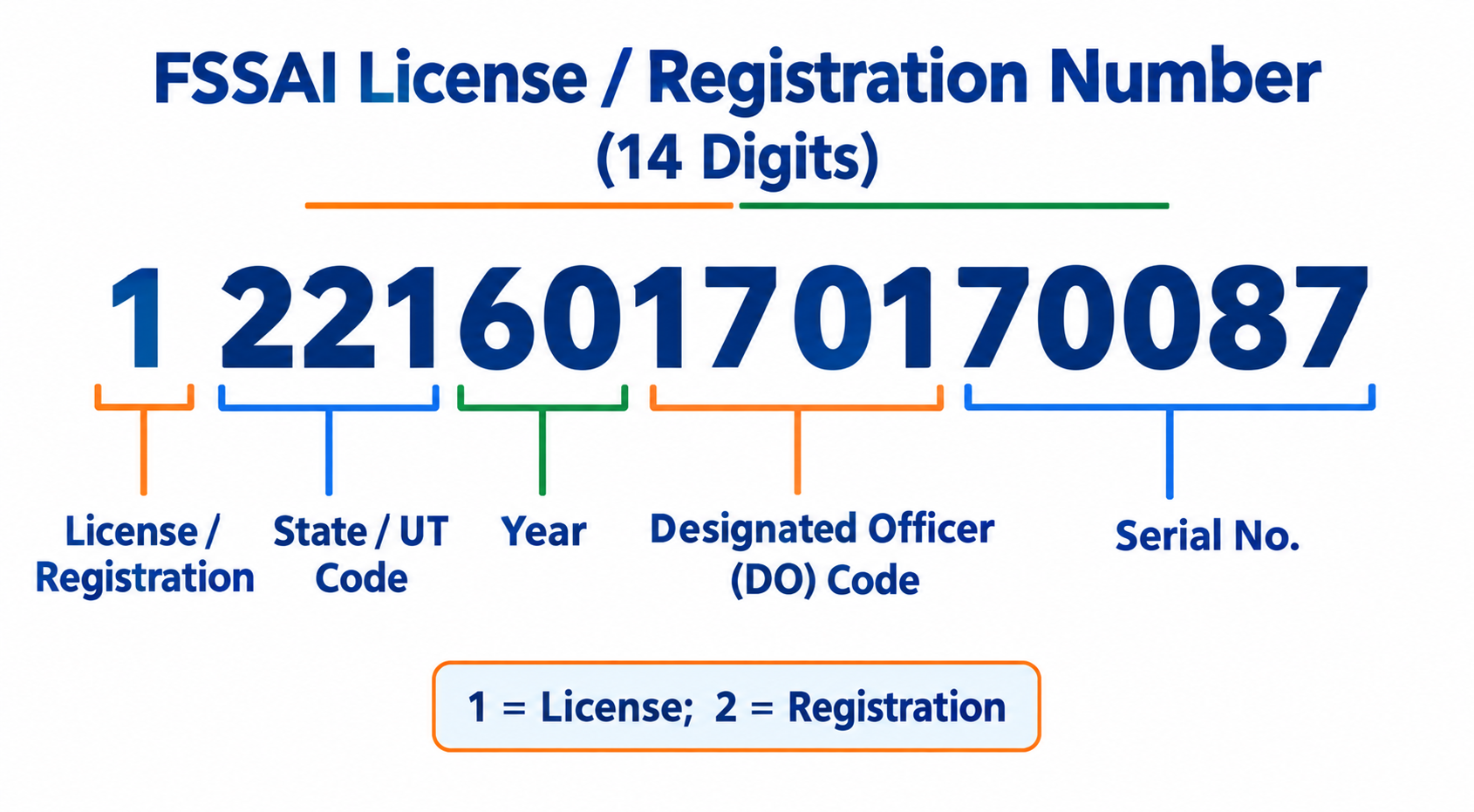
- First Digit: Registration status of the food business
- Second and Third Digit: Code of the state in which the food operations are performed
- Fourth and Fifth Digits: Year in which the food product is manufactured
- Sixth, seventh and Eighth Digit: Quantity of enrolling
- Ninth and Tenth Digit: Permit number granted to the maker or manufacturer
How to Apply for an FSSAI Central License Online Through FoSCoS?
Applying for an FSSAI Central License is an online process through the FoSCoS portal. Before submitting the application, make sure your business activity and Kind of Business (KOB) match the Central Licence eligibility criteria.
Simple Step-by-Step Process
Check Eligibility
Confirm that your business requires a Central FSSAI Licence.
Select the Correct KOB
Choose the business activity that accurately represents your food operations.
Prepare Documents
Keep business, premises, food product and other applicable documents ready.
Complete Form B
Enter the business, proprietor/director, premises and food activity details carefully.
Upload & Submit
Upload the required documents and submit the application through FoSCoS.
Pay the Government Fee
Pay the applicable statutory fee shown for your selected category.
Respond to Queries
If FSSAI raises a clarification or requires an inspection, provide the requested information.
Download the Licence
Once approved, download the Central FSSAI Licence and keep the certificate safely for future compliance.
Common Mistakes to Avoid When Applying for a Central FSSAI License
- Selecting the wrong KOB: Choose the correct Kind of Business based on your actual food business activity.
- Using old turnover limits: Check the latest 2026 FSSAI criteria before selecting the licence category.
- Submitting incomplete documents: Ensure all required documents and details are accurate and up to date.
- Incorrect product details: List food products that accurately match your business operations.
- Wrong premises information: Verify the business address and premises details before submission.
- Ignoring special requirements: Check applicable import, export and multi-State business requirements.
- Following old renewal rules: Review the 2026 perpetual validity provisions instead of relying on previous renewal practices.
- Not reviewing the application: Carefully verify every detail before submitting the application on FoSCoS.
Latest FSSAI Central License Updates in 2026
From 1 April 2026, FSSAI has introduced key licensing reforms for food businesses. The Central Licence threshold is now generally above ₹50 crore annual turnover, while FSSAI registrations and licences have perpetual validity, subject to ongoing compliance and regulatory action. The new framework also strengthens risk-based inspections and food-safety audits. Existing businesses should review their Kind of Business (KOB), turnover and licence details on FoSCoS and use the applicable migration or modification facility where required.
Government Schemes and Support Available to Food Businesses
Food businesses may benefit from various government initiatives designed to support food processing, business growth and food-safety compliance. Key programmes include:
- PMFME Scheme: Supports eligible micro food-processing businesses with financial and business assistance.
- PLISFPI: Provides incentives to eligible food-processing companies that meet the scheme’s requirements.
- FSSAI Training Initiatives: Helps food businesses improve food-safety practices through relevant training programmes.
- Business-Specific Eligibility: Benefits, funding and eligibility vary based on the business type, investment, turnover and scheme guidelines.
- FSSAI Licence: Having an FSSAI licence is a compliance requirement but does not automatically guarantee eligibility for any subsidy or government scheme.
FSSAI Registration vs State vs Central License – 2026
| Factor | Registration | State License | Central License |
|---|---|---|---|
| General turnover from 1 April 2026 | Up to ₹1.5 crore | Above ₹1.5 crore to ₹50 crore | Above ₹50 crore |
| Authority | Registration authority | State Licensing Authority | Central Licensing Authority |
| Activity-based Central categories | No | No | Yes, where applicable |
| Examples | Small eligible food businesses | Eligible State-level businesses | Importers, exporters, eligible e-commerce and specified Central categories |
Why Choose Kanakkupillai for FSSAI Central License Filing?
Applying for an FSSAI Central Licence requires more than simply uploading documents. The licence category, KOB, premises and product details should accurately reflect the actual food business. Kanakkupillai provides structured assistance to help businesses prepare and file their FSSAI application correctly.
- Eligibility-first review based on business activity and applicable criteria
- Accurate document preparation to keep the application organised
- Application verification before submission to reduce common errors
- FoSCoS filing assistance throughout the application process
- Compliance gap identification to highlight potential issues
- Clear and transparent service scope with no unnecessary steps
- Filing record support for better documentation and reference
- Single-point assistance from preparation through filing

Frequently asked questions
It is the FSSAI licence applicable to food businesses that fall under Central Licensing Authority criteria based on activity, turnover, capacity, location or other prescribed conditions.
Depending on KOB criteria, this can include importers, exporters, eligible e-commerce food businesses, certain large manufacturers, applicable multi-State businesses and specified airport, seaport and Central Government food operations.
For the general turnover-based classification from 1 April 2026, the Central Licence threshold is above ₹50 crore. Specific activities can require a Central Licence regardless of turnover.
Food importers are included among Central Licence categories under applicable FSSAI KOB criteria.
Exporters fall under Central Licence eligibility where the applicable FSSAI criteria apply.
FSSAI's KOB eligibility criteria include e-commerce food businesses under Central Licensing.
The statutory fee depends on the selected KOB. Many Central Licence categories show ₹7,500 per year in FoSCoS, but the exact current fee should be verified for the specific activity.
FSSAI introduced perpetual validity for registrations and licences under the 2026 reforms, subject to continued compliance and provisions relating to suspension, cancellation or surrender.
Yes, where the restaurant falls within applicable Central Licence criteria, including relevant turnover or other KOB conditions.
Yes. Applications are submitted through the FoSCoS online system.
The exact checklist varies by KOB. Common items include Form B, identity/address proof, business constitution details, product information and activity-specific supporting documents.
Businesses affected by revised thresholds or activity changes may need to use the applicable FoSCoS modification or migration process. The correct route depends on the licence and KOB.
Processing varies based on the application, documents, authority review, inspection requirements and queries raised. Avoid promising a guaranteed approval period.
The licence category and multi-State requirements should be checked against the applicable KOB and premises. A business should not assume one licence automatically replaces every premises-level requirement.
Not solely because a business is large. The exact KOB, turnover, capacity, location and activity should be checked against current FSSAI eligibility criteria.
Might Be Looking For




Trusted by 1,12,845+ Happy customers are using Kanakkupillai!